



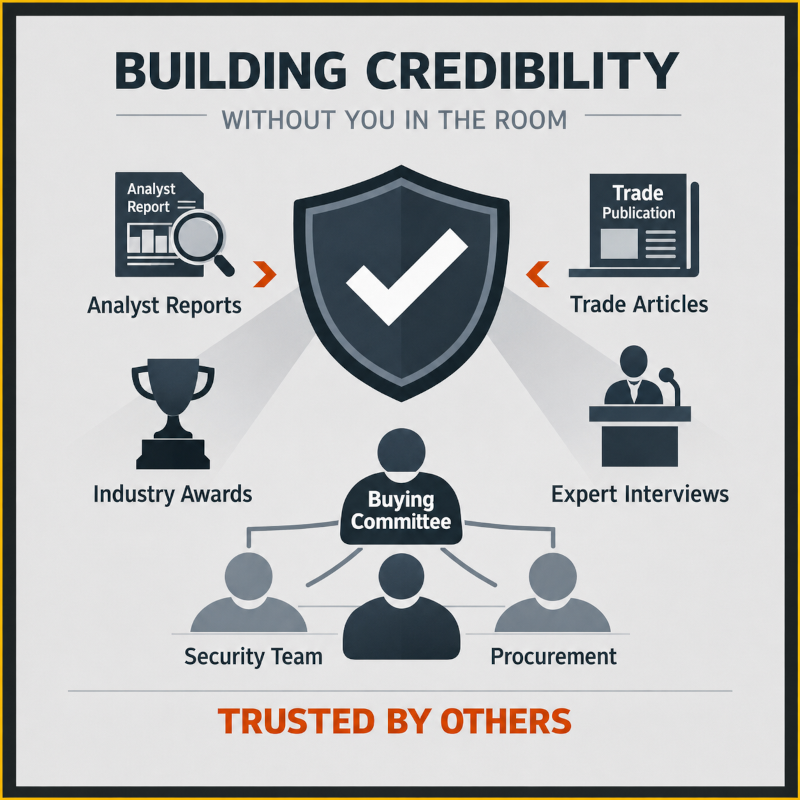
You can run a great demo, nail the Q&A, and still watch CISOs walk away from deals. Once the meeting ends, buying committees will seek signals from the market that your company is trusted and solves an important problem. They’ll look for independent validation that you understand their challenges and can deliver on your promises. Without that external credibility, you can lose momentum.
That’s where strong cybersecurity PR comes in. It’s third-party validation that tells your story in a way buyers trust. It can come from chats with cyber analysts, articles in publications like CSO Online, or executive features on podcasts like Humans in Cyber by TechNadu. Managing it can be a full-time job for a founder, but there’s a straightforward process you can use to make it work.
PR Builds Trust in Cybersecurity
You may think enterprise buyers should know about your new AI-powered anomaly detection feature or your single-pane-of-glass dashboards. But what they really want is proof from outside your company that CISOs can trust you. That could be a Gartner analyst note that mentions you, a founder quoted in trade press, or a name that’s been on an RSAC stage. That’s the legitimacy PR is designed to build.
Follow how a deal moves in an organization, and you’ll see what that looks like in practice. When your contact talks to a CTO, or when procurement asks “why this vendor?”, an analyst reference by Forrester or Gartner is the answer. Without those layers, your EDR or SIEM is asked to do the work of legitimacy on its own.
Should You DIY Cybersecurity PR?
Most founders start by doing PR themselves, then bring in outside help when sales begin to grow. When you can no longer justify spending 10-20 hours per week on external communication, an experienced PR partner can lighten the lift and give you better outcomes. The question isn’t whether you can do cybersecurity public relations yourself. It’s whether it’s the best use of your time when you’re running product development, hiring, and fundraising.
PR Plan for Founder-Led Sales
In founder-led sales, the founder is often the main source of trust. They explain the product, handle technical objections, reassure buyers, and lend credibility to the company. Most founders quickly find they need help managing the workload. Whether you choose to in-house your effort or team up with an experienced partner, you’ll want to think about the steps below required of a baseline public relations plan.
Conducting Media Outreach
Still wondering why you’re not getting featured in the Wall Street Journal or The New York Times? Your product isn’t the story. Start by building a list of 10-15 journalists who cover your niche. Then read their last three articles. When something newsworthy happens (a major breach or a new ransomware strain), send them a tight angle with your expert take. You can include one data point about your business, such as dwell time you cut or breaches you stopped. Craft your pitch to the audience reading their work.
Reporters remember vendors who make their lives easier. If you’re helpful, they may even come back for a comment on something directly in your area of expertise. Budget six hours per week for media outreach during the first month. Scale down to 3-4 hours weekly after you’ve built a stable of reliable journalists.
Reporters respond faster when you send tight, quotable context and make it easy for them to get the story.
Analyst Relations
Founders often ask, why isn’t Gartner asking to get a briefing with me? Analyst relations for cybersecurity vendors is about being the name analyst firms (like Gartner, Forrester, etc) mention when a CISO calls asking “who else is doing this?” The first step is getting a meeting on their calendar, which requires persistent and intentional outreach.
Once you get the briefing booked, keep it focused on outcomes and context. It’s better to say, “We shortened breach containment from days to hours” than, “Here’s how our policy engine maps to MITRE.” That said, every analyst firm has their own preferred style of engaging in a briefing, and the relationship should come first.
Awards and Speaking
Speaking opportunities and awards can build proof in the background. Start with a short list of awards and events your buyers recognize such as Black Hat, RSAC, and SINET 16. If you’re a founder leading sales, awards that cost over $700 to apply are not worth your budget.
Strong submissions read like buyer proof. Did you shave hours off MTTD or stop a breach in progress? You’ll get approvals from legal or customer stakeholders when you take time to pull those metrics. Different programs will have different time requirements to do the application justice, but plan to spend at least 2-3 hours crafting one. If your application is selected as a finalist or a winner, you can turn it into a sales asset that keeps working long after the event.
Contributed Byline Articles
Byline articles work when they’re not crammed with product details. They have to remain vendor neutral. To get published by an editor, start by choosing 5-10 publications CISOs read, then skim their headlines. If you notice topics they haven’t covered yet, that’s your opening to craft something new and interesting that would add value and insight to readers.
Find the right editor by checking the publication’s masthead or About Us page. Some have a dedicated “submit a pitch” page that tells you who handles contributed content.
The best pitches are short with a clear thesis and a reason it matters. Write clean copy with real sourcing, then accept edits without letting it turn into marketing copy. Expect back-and-forth on claims and headlines. You’ll spend well over 5 hours per published byline once you account for the pitch, the draft, and the editor’s back-and-forth.
Product Launches
Product launches are exciting for your team, but not so much for people on the outside. It’s key to write your message so an outside audience knows why they should care.
A launch works when it’s clear what buyer problem it can solve. How are you helping CISOs get time back for their security teams? How are you making it easier for boards to understand the security posture of their organization? Carve out at least 2-3 days founder time to build an expertly drafted launch plan, plus time for everything to go through legal. Prep spokespeople, research reporters to contact, and include a short customer quote and FAQ list your sales team can reuse.
Media Interactions
If a reporter isn’t using your interview answers, they may be too long or technical. Don’t spam them with a detailed rundown of your ML stack or rules taxonomy. Instead, write quotable lines that give value to the publication’s target audience.
When you do have an opportunity to give an interview, try to give 15-second answers that land one point. If you can’t do that in person, take the conversation offline and follow up. Finally, consider your key topics before you speak with the reporter. Allow at least 30 minutes of prep time per media interaction.
What an Outsourced Communications Partner Handles
A strong outsourced communications partner turns your ideas into polished deliverables without pulling you into every thread. They do the follow-ups and manage deadlines you’ll never get to in a sales-heavy week. They’ll also do the vetting, analyst relations, awards submissions, guest articles, and other pieces that create real proof.
You’ll stay on the hook for your POV, technical accuracy, and the call on what’s off limits to say in public. If you’re choosing a communications partner, look for someone who has a clear process for approvals. They should also understand CISOs, security architects, and procurement enough to write cleanly. Finally, they’ll know when to tell you “don’t push this” if a story creates more friction than sales. You are looking for a partner, not a “yes team”.
FAQ
How Much Founder Time Does Cybersecurity PR Actually Take?
PR can be a full-time job without the help of a partner. With a PR partner, your time investment drops to a check-in every other week, plus on the fly approvals on things like commentary attributed to you for reporters, byline drafts or award submissions. Your job is to provide the raw inputs when they need a founder voice, like an analyst call or interview.
What Will Cybersecurity Public Relations Not Do for You?
PR won’t fix a broken ICP, and it will not generate a predictable flow of inbounds. PR is also not a guarantee of instant media fame. The best PR teams are up front about the time, effort and work that goes into achieving external communication wins. You’re paying an agency for their expertise and effort.
Is PR Worth It Before You Hire a VP of Sales?
It can be, because it gives reps something credible to lean on even when you aren’t on the call. Case in point: when you bring on your first AEs and your conversion rate dips, third-party proof helps your reps sound like they’re selling a known company.
What’s a Reasonable Way to Think About Cost?
Don’t compare it to a one-off press release. Weigh it against the cost of another senior hire, then ask whether consistent analyst, speaking, awards, and thought leadership output would shorten sales cycles or reduce late-stage stalls enough to matter.
Let’s tell your story in a way that gets heard. Connect with LaunchTech to schedule a discovery conversation.